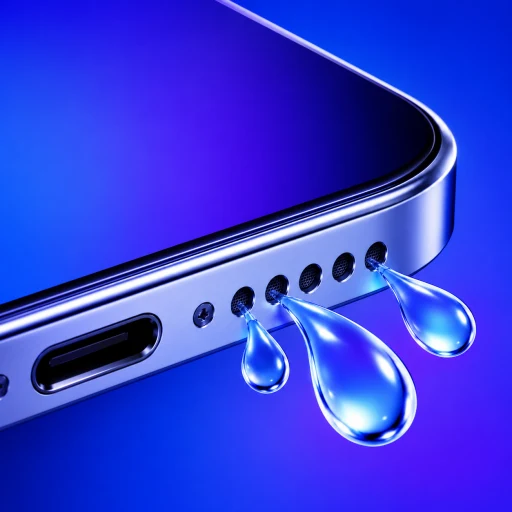
When water enters an iPhone or Android phone speaker, audio instantly turns muffled, quiet, or crackly. Searching for solutions online leads thousands of people to queries like "fix my speaker vibrate" or apps claiming to "vibrate water out of phone."
It seems intuitive: if something is wet, shaking it violently ought to dislodge the water.
However, relying on your phone's vibration motor to clear water is a mechanical misconception. Vibration motors cannot clear speaker moisture, and understanding the physical difference between chassis vibration and acoustic air displacement explains why.
How Do Phone Vibration Motors Differ From Loudspeakers?
Inside modern smartphones, two distinct components produce physical motion, but they operate on opposite physical principles:
1. The Vibration Motor (Taptic Engine / LRA)
Modern smartphones use a Linear Resonant Actuator (LRA) or, in iPhones, the Taptic Engine.
- It consists of a dense metal mass (often tungsten) suspended on springs inside a hermetically sealed aluminum case.
- An electromagnetic coil pushes the mass rapidly back and forth along an axis at approximately 150 Hz to 170 Hz.
- Because the unit is completely airtight, it moves zero air. It transfers kinetic energy strictly through the phone’s structural frame to your fingertips to simulate button presses and ringtone buzzes.
2. The Loudspeaker Assembly
The bottom speaker assembly is an acoustic transducer open to the outside world:
- It consists of a permanent magnet, a copper voice coil, and a flexible polymer diaphragm (cone) suspended inside an acoustic cavity.
- When an electrical audio signal passes through the coil, the diaphragm moves outward and inward violently.
- This motion physically compresses and displaces the air in front of it, pushing sound waves—and physical air currents—out through the speaker grilles at the bottom of the phone.
| Characteristic | Vibration Motor (Haptic Engine) | Loudspeaker Assembly |
|---|---|---|
| Moving Element | Solid tungsten weight | Flexible polymer cone / diaphragm |
| Enclosure | Hermetically sealed metal box | Open acoustic duct to external grille |
| Air Movement | Zero airflow (internal mass only) | Physical air displacement |
| Effect on Trapped Water | Shakes outer glass frame | Pushes air outward through mesh holes |
| Water Ejection Capability | Ineffective | Effective via acoustic pulse |
Why Do Capillary Action and Surface Tension Trap Water in Speakers?
Why doesn't water simply fall out of a speaker grille when you hold the phone downward?
Smartphone speaker ports are protected by a fine, laser-etched mesh treated with a hydrophobic (water-repelling) coating. The holes in this mesh are fractions of a millimeter wide.
When water enters the port:
- Surface tension forms a convex elastic skin across the tiny pores of the mesh.
- Capillary pressure holds the liquid droplet stubbornly wedged inside the aperture.
- This liquid barrier blocks sound waves from propagating, causing callers to sound distant and muffled.
Shaking the phone frame with a vibration motor does not create enough localized shear force to overcome the surface tension of the droplet. The phone vibrates in your hand, but the water droplet remains firmly held by surface tension against the mesh.
Why Do 165 Hz Sound Waves Clear Water When Vibration Cannot?
To eject a droplet of water from a micro-aperture, you need a pressure differential: the air pressure behind the water droplet must exceed the atmospheric pressure and surface tension holding it from the front.
This is precisely what a dedicated low-frequency sound tone does:
- When a pure 165 Hz sine wave plays at maximum volume, the loudspeaker diaphragm oscillates back and forth 165 times per second.
- Because 165 Hz falls near the natural acoustic resonance of the smartphone speaker chamber, the speaker cone reaches its maximum mechanical excursion (physical travel distance).
- Every forward stroke of the diaphragm acts as a miniature pneumatic piston, creating high-pressure air pulses behind the speaker mesh.
- These acoustic pulses shear through the liquid's surface tension, breaking the droplet into tiny beads and pumping them out through the grille holes.
What Is the Safe Protocol for Clearing a Wet Phone Speaker?
If your phone has been exposed to water and audio is distorted:
- Wipe the exterior: Dry the glass, frame, and grilles with a lint-free microfiber cloth.
- Position the phone: Stand the phone upright with the bottom speaker ports angled downward toward a paper towel so gravity assists fluid exit.
- Play a dedicated water eject tone: Run our Water Eject sound tool or iOS shortcut for 15 to 30 seconds. You will see microscopic mist or beads appear on the exterior speaker grille.
- Wipe and repeat: Dab away the expelled droplets immediately so they are not drawn back inside.
- Let ambient air finish drying: Allow the phone to sit in a dry, ventilated room. Do not insert cotton swabs, toothpicks, or blast the port with compressed air, which can rupture the internal water-resistant adhesive seals.
Frequently Asked Questions
Why do some apps say "Vibrate to Clean Speaker"?
Many mobile apps use misleading marketing, bundling a simple screen toggle that activates the phone's standard vibration motor while playing a generic buzzing sound. While the phone buzzes in your hand, the vibration motor does nothing to move trapped moisture. Only the audio component of the app provides functional ejection.
Can water in the speaker damage the phone permanently?
Modern water-resistant phones (rated IP67 or IP68) have water-resistant membranes sealing the internal circuitry from the speaker chamber. While water trapped in the speaker mesh causes temporary audio muffling, it will not enter the main logic board unless the phone's adhesive seals are compromised by age or physical drops.
Should I put my phone in a bowl of rice while vibrating it?
No. The rice myth has been thoroughly debunked. Rice does not accelerate drying, and fine starch dust combined with moisture forms a paste that clogs speaker grilles. Furthermore, running vibration motors while the phone is trapped in rice can shake abrasive dust particles into open ports.
Questions about phone speaker vibration vs acoustic water ejection
Can using a vibration app fix a water-damaged phone speaker?+
No. Vibration apps activate the phone's internal haptic motor, which shakes the phone's outer frame. The haptic motor has no physical connection to the speaker grille and creates no airflow. To expel water, you must use an acoustic sound tone played through the speaker itself.
What is the difference between the Taptic Engine and a loudspeaker?+
The Taptic Engine is a sealed Linear Resonant Actuator (LRA) that moves a tungsten mass back and forth inside an airtight enclosure to simulate tactile clicks. A loudspeaker consists of a voice coil attached to a flexible diaphragm open to the atmosphere, designed specifically to move air columns.
Why does water get stuck in the speaker grille in the first place?+
Water gets trapped by capillary action and surface tension. The microscopic openings in the hydrophobic speaker mesh create high surface tension that holds droplets in place like a seal, preventing sound from passing until broken by acoustic pressure or evaporation.
Can heavy vibrations damage a wet phone?+
Running a phone's vibration motor continuously for extended periods creates internal heat without moving air, which can cause moisture to evaporate and recondense deeper inside internal camera modules or sensors.